Worlds Before This World
In central Mexican traditions commonly called the myth of the Five Suns, the present world was not the first. Earlier ages each had their own sun and inhabitants. Rival divine powers shaped them, and each ended in catastrophe.
Surviving sources disagree about the order and details. One world is associated with jaguars, another with destructive wind, another with fiery rain, and another with a flood whose people become fish. The differences reflect the fact that the Five Suns is a family of related accounts rather than one perfectly fixed text.
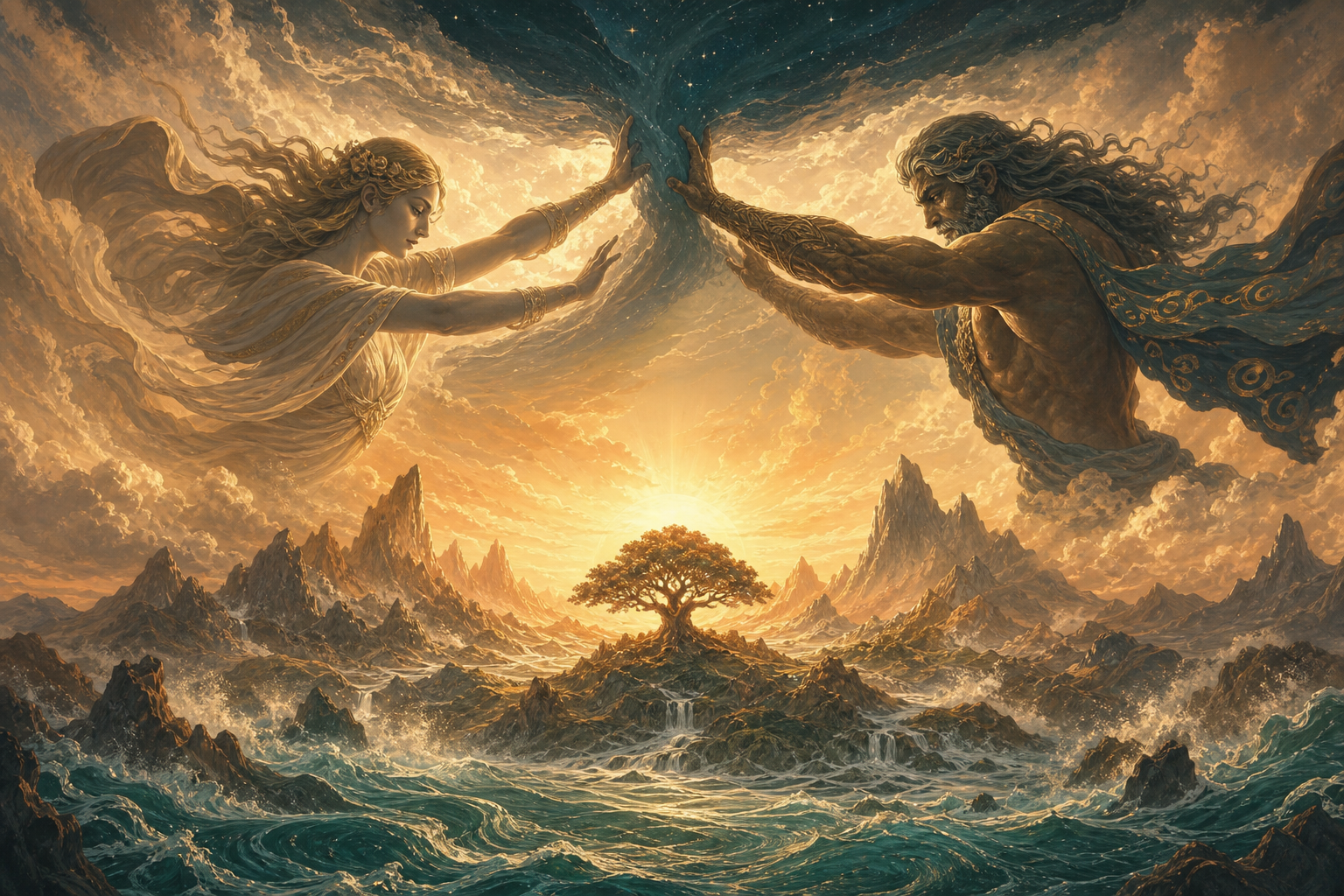
After four destructions, the cosmos was dark and motionless. The gods gathered at Teotihuacan to create a new sun.
Two Gods Approach the Fire
The gods called for a volunteer to leap into a sacred fire. Tecciztecatl, wealthy and proud, offered himself. The humble, afflicted god Nanahuatzin was chosen as a second candidate.
Tecciztecatl presented magnificent offerings. Nanahuatzin offered simple, sincere gifts. When the moment came, Tecciztecatl approached the flames four times but lost his courage each time. Nanahuatzin closed his eyes and jumped. Ashamed, Tecciztecatl followed.
Two brilliant lights rose in the sky. The gods had not intended two equal suns, so one threw a rabbit at Tecciztecatl’s face, dimming him into the Moon. The image of the rabbit can still be seen in the lunar markings in Mesoamerican tradition.
The Sun Refuses to Move
Although Nanahuatzin had become the new sun, he remained still. The new age could not begin until the other gods also gave themselves. They sacrificed their lives, and wind set the sun in motion across the sky.
The present era is therefore founded on divine sacrifice. Light and movement are not effortless gifts; they exist because the gods accepted a cost.
Humanity Remade
A related creation account tells how Quetzalcoatl descended to Mictlan, the underworld, to recover the bones of people from previous ages. The lord of the dead tried to prevent him from leaving. Quetzalcoatl escaped with the bones, though they broke during the struggle.
The bones were ground, and the gods added their blood. From this mixture, humanity was created again. Differences among people were sometimes explained by the broken bones.
A Precarious Fifth Sun
The Fifth Sun is often called the Sun of Movement. It too is destined to end, commonly through earthquake or motion. The story gives the present world both sacred value and instability. It has survived where others failed, but it is not guaranteed forever.
For the Mexica, often called the Aztecs, sacrifice was connected with the continuing life of the cosmos. Modern readers should approach this subject with care: colonial sources, Indigenous accounts, archaeology, and later interpretation do not always agree, and sensational retellings can distort the tradition.
At the heart of the myth is reciprocity. The gods give themselves so the sun can move; humans live within a world sustained by that gift and by ongoing responsibility.
Wikipedia Sources
This original retelling is based on Five Suns, Nanahuatzin, Aztec mythology, and Mesoamerican creation myths on Wikipedia.