
Ten Suns in the Sky
In a famous cycle of Chinese legends, ten suns once took turns crossing the heavens. One day they appeared together. Their combined heat scorched the fields, dried the rivers, and threatened every living thing.
Hou Yi, an archer of extraordinary skill, climbed to a high place and shot nine suns from the sky. He left one to warm the earth and mark the days. For saving the world, Hou Yi was honored as a hero. In many tellings, the Queen Mother of the West rewarded him with an elixir that could grant immortality.
Hou Yi did not immediately drink it. He loved his wife, Chang’e, and did not wish to enter the immortal realm without her. He entrusted the precious medicine to her while he continued his duties.
Why Chang’e Drank the Elixir
The story’s turning point changes from version to version. In one popular telling, a man named Peng Meng tried to steal the elixir while Hou Yi was away. Chang’e swallowed it to keep it from the thief. In another, she drank it deliberately, and the act is judged more harshly. Older traditions also tell the relationship between Chang’e, the archer, and immortality in different ways.
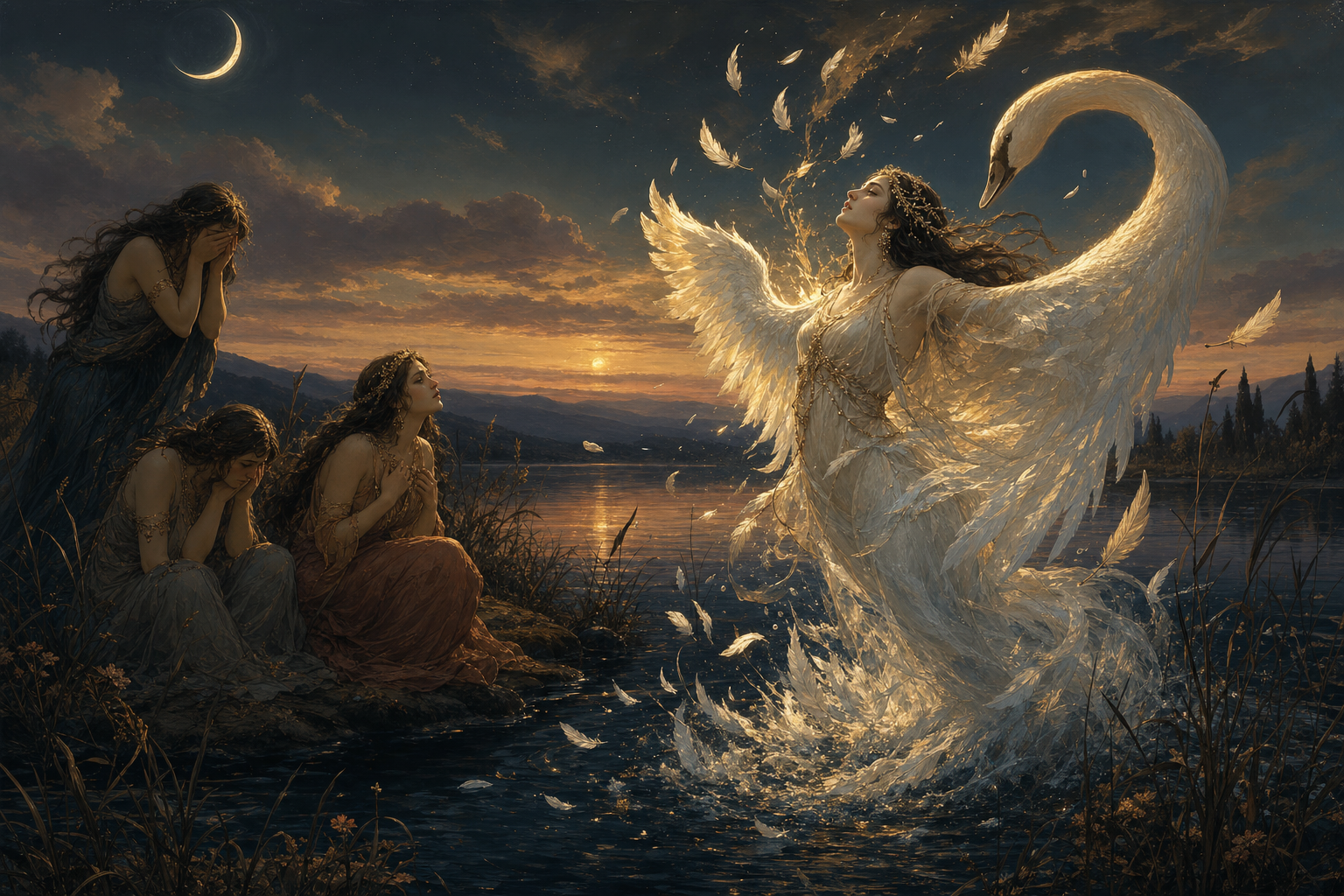
Whatever her reason, the result was the same. Chang’e became weightless. She rose from the earth, passed beyond the rooftops and clouds, and traveled toward the Moon.
She chose the Moon because it was close enough to the human world for her to remain near Hou Yi. Yet closeness did not end their separation. Chang’e entered the cold, luminous lunar palace while Hou Yi remained below.
The Moon Palace
On the Moon, Chang’e is often accompanied by the Jade Rabbit, who pounds the medicine of immortality in a mortar. Another lunar figure, Wu Gang, endlessly cuts a tree that heals after every blow. Together, these images make the Moon a realm of immortality, repetition, beauty, and loneliness.
When Hou Yi discovered what had happened, he grieved. Seeing the Moon shine with unusual clarity, he placed Chang’e’s favorite foods outside as an offering. Later tellings connect this act of remembrance with traditions surrounding the Mid-Autumn Festival, when families gather beneath the full Moon.
Meaning and Versions
Chang’e’s legend is not a single fixed narrative. Across centuries she has been portrayed as self-sacrificing, impulsive, ambitious, tragic, or unfairly separated from the person she loves. The tale can warn against grasping for immortality, praise a courageous choice made under threat, or explain why the Moon evokes longing for absent family.
At its center is an impossible exchange: Chang’e gains endless life but loses ordinary companionship. She can look down upon the human world forever, while those below look up and remember her.
Wikipedia Sources
This original retelling is based on the Wikipedia articles Chang’e, Hou Yi, and Mid-Autumn Festival. The articles document multiple versions; this story preserves that variation rather than treating one modern telling as definitive.