Lir’s Family
Lir, a lord of the Tuatha Dé Danann, had four beloved children: Fionnuala, Aodh, and the twins Fiachra and Conn. After their mother died, Lir married her sister Aoife, hoping she would care for them.
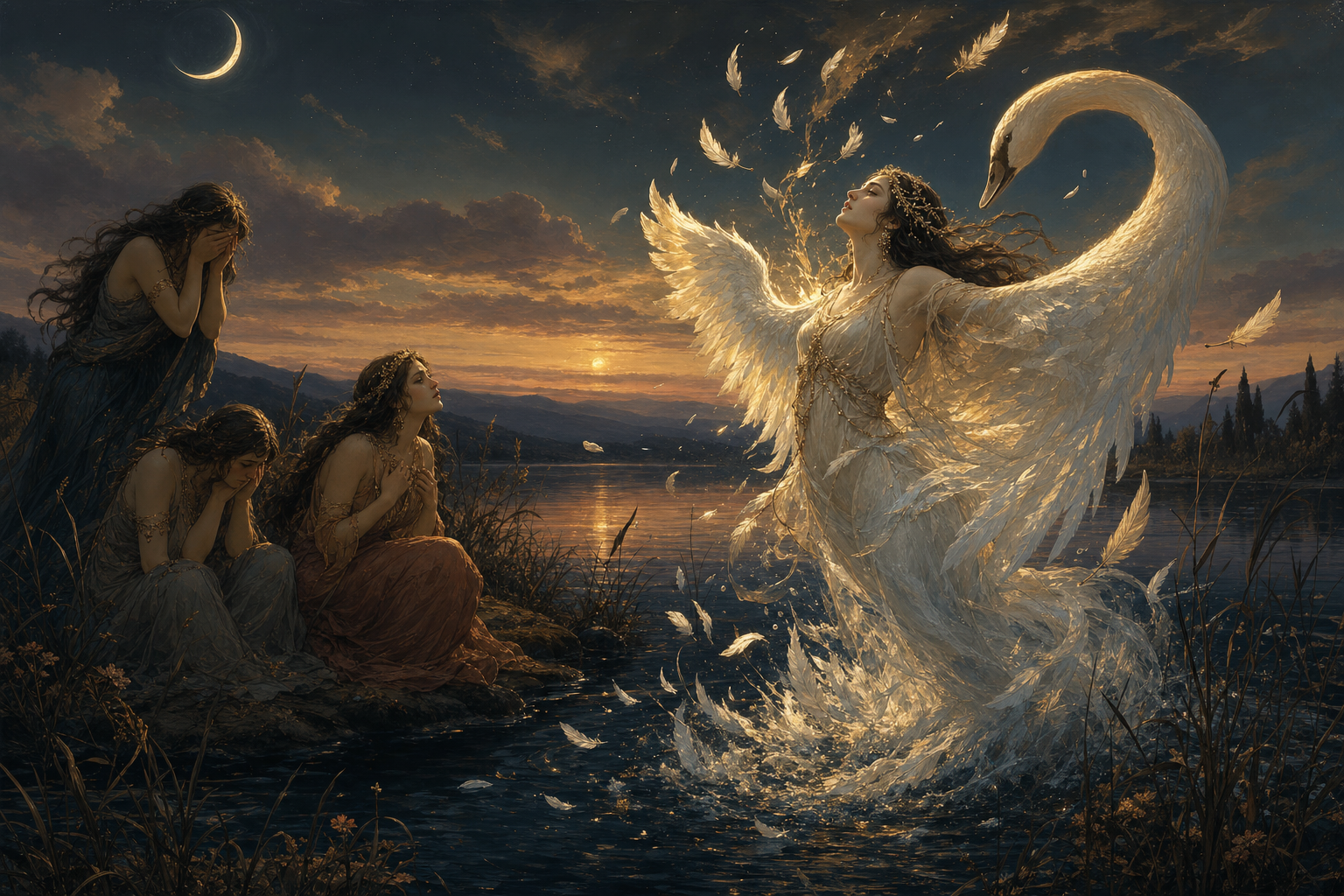
At first Aoife loved the children, but jealousy grew as she saw the depth of Lir’s affection for them. During a journey, she brought the children to a lake. There she used magic to transform them into four white swans.
Aoife could not take their voices. Fionnuala and her brothers could still speak and sing with haunting beauty. She also could not bring herself to kill them. Instead, she pronounced a long sentence of exile: they would spend centuries on three different waters before the enchantment could end.
Three Hundred Years on Loch Derravaragh
The swans first lived on Loch Derravaragh, near their father’s home. Lir discovered what Aoife had done and punished her, while he and his people came often to hear the children sing.
Those first centuries were sorrowful, but the lake was familiar. The children could still see people they loved. Fionnuala protected her younger brothers, arranging her wings around them when the nights grew cold.
At the appointed time, they had to leave.
The Sea of Moyle
Their next home was the rough Sea of Moyle between Ireland and Scotland. Winter storms scattered them across the dark water. Fionnuala feared she had lost her brothers, but they found one another again. They survived cold, hunger, and loneliness by remaining together.
The years changed the world beyond them. The age of the Tuatha Dé Danann faded. Friends and familiar places disappeared, while the swans continued to live under Aoife’s spell.
The Western Ocean
For their final centuries, the children traveled to waters in the west, often associated with the Atlantic near Erris and Inishglora. They endured another long exile as human generations passed.
Eventually they heard a bell associated in later Christianized versions with the arrival of Saint Patrick’s faith in Ireland. A holy man gave them shelter. The precise conditions of their release vary among tellings, and a king’s attempt to seize them sometimes triggers the final change.
The spell broke. The four swans became human again, but not as children. The centuries reached them at once, leaving them extremely old. They were baptized in Christian versions of the tale and died together, with Fionnuala still caring for her brothers.
A Story of Time and Loss
The Children of Lir is often included among the “Three Sorrows of Storytelling” in Irish tradition. Its tragedy is not only the transformation. The children keep their minds and voices while the world they know vanishes around them.
Fionnuala is the story’s center of endurance. She cannot end the spell, but she can keep the family together through storms, cold, and centuries. Their song preserves identity when almost everything else has been taken.
The surviving tale is a literary work shaped over time, and its Christian ending sits alongside its mythological setting. Different retellings vary in names, locations, durations, and the final release.
Wikipedia Sources
This original retelling is based on Children of Lir, Lir, and Tuatha Dé Danann on Wikipedia.