
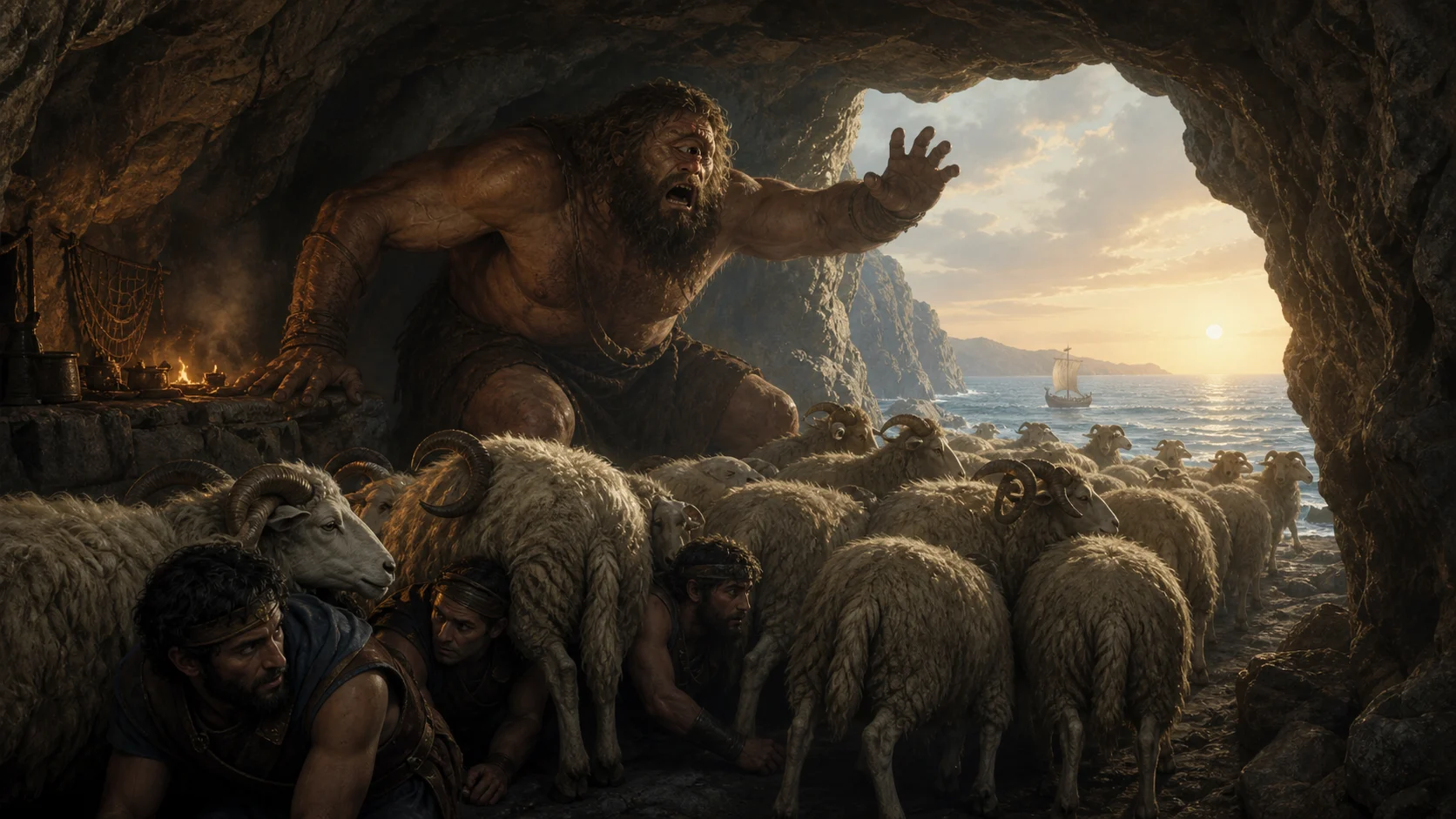
The encounter between Odysseus and the Cyclops is one of the purest intelligence-against-force stories in all mythology. Yet it is not a simple celebration of cleverness. Odysseus escapes because he is cunning, but his own need to be known turns escape into a curse.
Entering the Cave
After the fall of Troy, Odysseus and his companions wander far from home. On reaching the land of the Cyclopes, he does what many Greek heroes do at the edge of danger: he lets curiosity override prudence. Rather than taking provisions and leaving, he enters the cave of Polyphemus to see what manner of being lives there and whether the laws of hospitality will be honored.
That choice is crucial. Greek myth and epic care deeply about guest-friendship, the sacred duty to receive strangers properly. Odysseus approaches the cave expecting, or at least hoping, to meet a host. Instead he meets a creature outside civilized custom.
Polyphemus returns with his flocks, seals the cave mouth with a stone too heavy for ordinary men to move, and asks the strangers who they are. When Odysseus appeals to Zeus’s protection of guests, the Cyclops mocks the appeal. Then he takes some of the men and eats them. The violation is total: hospitality reversed into cannibalism.
The Plan of “Nobody”
Odysseus cannot kill Polyphemus at once, because only the giant can move the stone blocking the cave. So the hero has to solve the problem in stages. He must disable the monster without trapping himself forever in the cave. This is exactly the kind of problem at which Odysseus excels.
He offers Polyphemus strong wine, a gift whose sweetness hides its function. The giant drinks greedily and asks his guest’s name, promising him the favor of being eaten last. Odysseus answers that he is called Nobody.
When Polyphemus collapses into drunken sleep, Odysseus and his chosen men harden a stake in the fire and drive it into the Cyclops’s single eye. The giant roars and calls for help. But when the neighboring Cyclopes ask who is hurting him, he answers, “Nobody,” and so his rescue fails at the level of language. Odysseus has turned a name into a weapon.
Escape Under the Rams
Blinded and enraged, Polyphemus gropes for the men, but he still controls the cave mouth. In the morning he sits at the exit and feels the backs of the sheep as they leave, certain the Greeks will try to slip out with the flock. Odysseus again escapes by thinking along a different line. He ties his men beneath the bellies of the animals, using the flock itself as cover. He clings under the strongest ram and passes safely out.
This is one of the great moments of Greek heroic intelligence. Force could wound Polyphemus, but only imagination could get living men past the sealed threshold. The escape is humiliating for the giant, yet the story does not stop there.
The Fatal Boast
Once back at sea, Odysseus cannot resist speaking. First he taunts Polyphemus from a distance. Then, when his companions urge silence, he goes further and reveals his true name. The need for recognition overwhelms the caution that had just saved everyone.
That boast transforms the whole episode. Now Polyphemus knows whom to curse. He calls on his father, Poseidon, to avenge him. Since Polyphemus is the son of the sea-god, the prayer matters. From that moment the escape from the cave becomes the beginning of a much longer suffering. Odysseus has won the encounter and damaged his own homecoming in the same breath.
Greek epic loves this kind of reversal. The hero is admirable precisely because he is gifted beyond ordinary men, but the same gift can carry its own flaw. Odysseus’s intelligence saves him; his hunger for fame endangers him.
Why This Story Lasts
The myth remains unforgettable because its structure is so exact. A cave becomes a prison. A cup of wine becomes strategy. A false name becomes a shield. Sheep become vehicles of escape. Then pride turns victory into future loss. Every part of the story is active; nothing is decorative.
It also captures a central Greek contrast between civilized order and raw appetite. Odysseus is not morally pure, but he belongs to a world of speech, planning, exchange, and memory. Polyphemus belongs to a world of appetite without law. The clash between them therefore feels larger than one man’s escape. It is a contest between forms of life.
Sources and Tradition
- This retelling follows the ancient material collected on Theoi’s Polyphemus page, which summarizes the Odyssey tradition.
- For broader reference context, see Wikipedia on Odysseus and Bulfinch’s public-domain retelling of Ulysses among the Cyclopes.