The story of Theseus and the Minotaur is one of the defining myths of Athens. It is about a monster, certainly, but even more about political humiliation, voluntary courage, and the frightening possibility of entering a place designed so that no one comes back out.
The Prince Who Chose the Hard Road
Theseus is raised away from Athens and only later comes to claim his place as son of King Aegeus. On his journey he chooses the dangerous road by land rather than the safer voyage by sea, defeating robbers and violent men on the way. Greek tradition uses that journey to establish his character early: he is not merely strong, but determined to clear the world around him of the things that make travel and civilized life impossible.
When he finally reaches Athens, he finds a city living under shame. Because of older conflict with Crete, King Minos demands a recurring tribute of Athenian youths and maidens. They are sent across the sea to the labyrinth, where the Minotaur devours them. The tribute is both political punishment and living nightmare. Athens is forced to feed its children to a foreign terror.
The Minotaur itself is born from disorder inside the house of Minos. It is the monstrous offspring of Pasiphae and a divine bull, half human and half beast. Minos does not destroy it. Instead he hides it in a structure built by Daedalus, a maze so cunning that those who enter cannot find the way out again. Violence is not removed; it is contained and institutionalized.
The Labyrinth
Theseus volunteers to join the doomed company bound for Crete. That decision is central to the myth. He is not ambushed by fate or tricked into danger. He chooses to descend into a civic terror on behalf of his city.
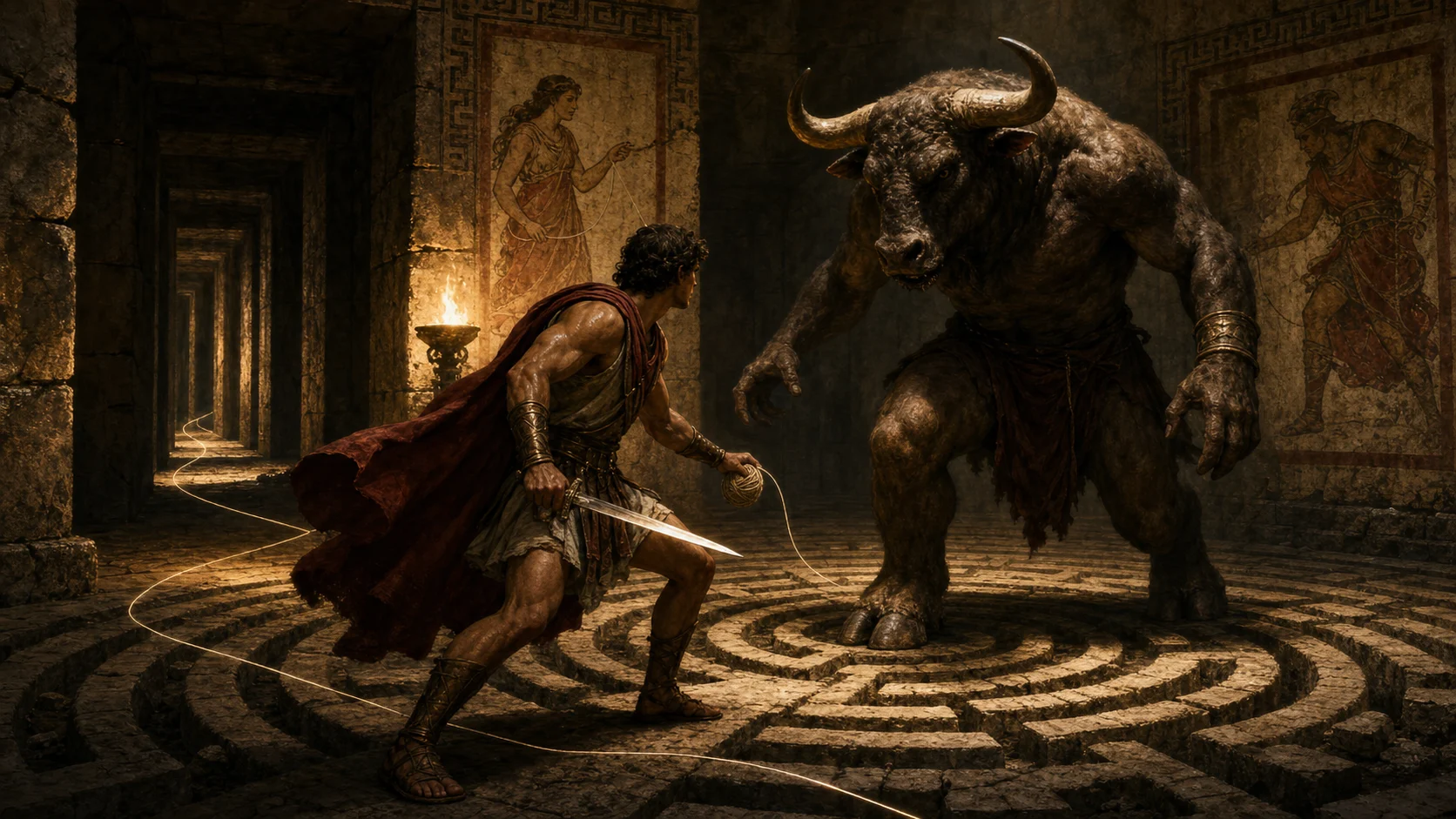
When the Athenian group arrives, Ariadne, daughter of Minos, sees Theseus and decides to help him. Her aid is as essential to the story as his courage. She provides a sword and, in the most famous detail of the myth, a thread. The plan is simple in outline and terrifying in execution: enter the labyrinth, unspool the thread behind him, find the Minotaur, kill it, and use the thread to retrace the way out.
The image of the labyrinth is what gives the myth much of its enduring power. A monster can be fought. A maze does something subtler. It confuses direction, weakens memory, and makes return uncertain. Theseus must face not only a beast but the structure that protects it.
The Killing of the Minotaur
Inside the winding passages, Theseus follows the thread deeper and deeper until he reaches the place where the Minotaur waits. Ancient sources differ over the exact manner of the kill. Some emphasize the sword; others even suggest that Theseus overpowered the creature with his bare hands. But all agree on the essential outcome: the devourer of Athenian children is finally brought down.
The victory matters because it ends more than one life. It ends a cycle. Each tribute ship had repeated the same horror, turning public fear into annual custom. By killing the Minotaur, Theseus breaks the machinery of that fear at its center.
He then takes Ariadne’s thread and leads the survivors back through the maze. This second half of the action is as important as the combat. In a labyrinth, killing the monster is not enough. One must also remember the path home.
Return, Loss, and the Black Sail
Theseus escapes Crete with the rescued Athenians and Ariadne. But the story refuses to remain purely triumphant. On the journey back, Ariadne is left behind on Naxos. Greek tradition gives multiple explanations. Sometimes Theseus abandons her; sometimes a god claims her; sometimes destiny rather than ingratitude drives the separation. The variations matter because they show that even the heroic version of Theseus is morally mixed.
The darker stroke comes near home. Before leaving Athens, Theseus had promised his father that if he returned successful he would replace the ship’s black sail with a white one. Yet in grief, distraction, or simple forgetfulness, the black sail remains. Aegeus sees the ship from afar, believes his son dead, and throws himself into the sea that later bears his name.
So Theseus returns victorious, but not untouched. He has saved Athens and become its great hero, yet he enters kingship through a father’s death and a broken promise. Greek myth repeatedly insists that glory and loss arrive together, and this tale is one of its sharpest examples.
Why This Story Lasts
Theseus and the Minotaur endure because the story combines several kinds of fear at once. There is the fear of the beast, the fear of being trapped, the fear of public helplessness, and the fear that even after victory something essential may still be lost. The thread remains one of mythology’s perfect symbols: intelligence, memory, and continuity stretched through confusion.
That is why the myth belongs not only to monster stories but to political imagination. Theseus is remembered as the hero who entered the place where his city’s terror was housed and came back with a path for others to follow.
Sources and Tradition
- This retelling follows the classical outline preserved on Theoi’s Minotaur page and broader hero summaries connected with Theseus.
- For the standard overview of Theseus’s role in Greek legend, see Wikipedia’s Theseus entry and Bulfinch’s public-domain chapter on Theseus and Daedalus.