Atlas is one of the easiest figures in Greek mythology to picture and one of the hardest to forget. He is not remembered mainly for a speech, a romance, or even a victory. He endures. Greek myth turns him into the image of impossible burden made permanent.
A Titan on the Losing Side
Atlas belongs to the older divine generation, the Titans who ruled before the Olympian gods secured the cosmos. When Zeus led the younger gods against the Titanes in the great war for rule, Atlas fought with the losing side. Ancient sources often single him out as one of the Titan leaders, which helps explain why his punishment is so striking.
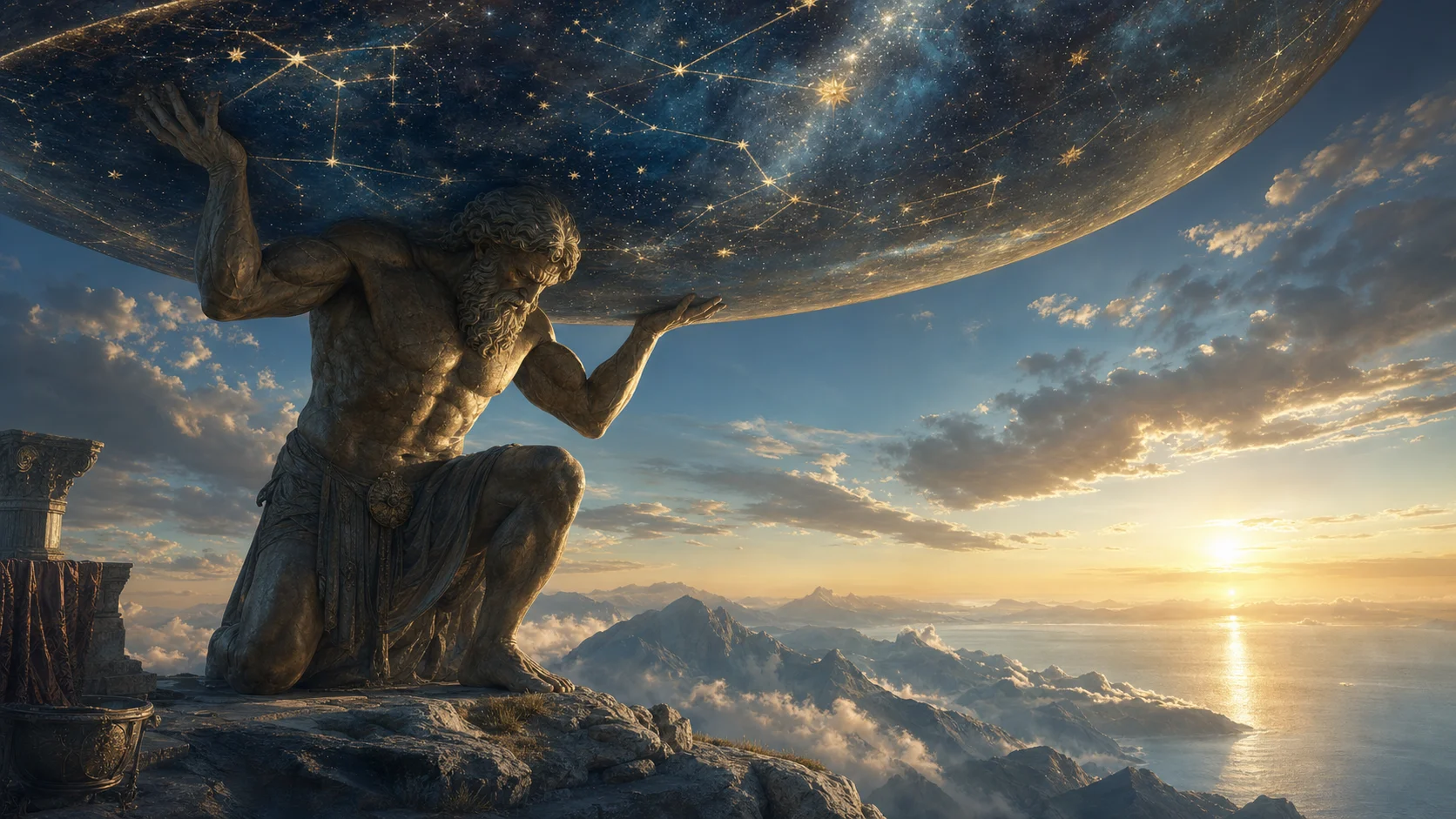
After the defeat, Zeus does not merely cast Atlas into obscurity. He assigns him a cosmic labor. Atlas must stand at the edge of the world and bear the heavens aloft upon his shoulders. In some versions he is imagined literally holding sky away from earth; in others he guards the pillars that keep them apart. In either case the myth is about separation, strain, and endurance without relief.
This is one of the most important details in the story: Atlas does not originally carry the earth. The familiar globe-bearing image is later and modernized. In the older myth he bears the sky or the heavenly vault. That difference matters because the punishment is not just weight. It is cosmic architecture. Atlas becomes the living support that keeps the world from collapsing back into confusion.
More Than a Punished Giant
Atlas is not only brute strength made stationary. Some Greek traditions also connect him with knowledge of the stars and the ordering of the heavens. That suits his position. If one is fixed beneath the turning sky forever, one becomes intimately linked with its motions. Sailors, seasons, and the idea of celestial measurement all gather naturally around him.
This gives Atlas a depth beyond simple suffering. He is the Titan of endurance, but also a figure through whom Greek myth imagines the sky as something legible. The burden and the knowledge belong together.
Atlas and Heracles
Atlas enters hero myth most memorably during the labors of Heracles. One of Heracles’ final tasks is to obtain the golden apples of the Hesperides. These apples belong to a remote and sacred setting, and Atlas is connected to that western region through his daughters and his position at the margin of the world.
Prometheus, in some accounts, advises Heracles not to seize the apples himself but to ask Atlas to fetch them. Heracles agrees to take the heavens on his own shoulders while Atlas goes in search of the fruit. The arrangement is remarkable because for a brief moment the most enduring burden in mythology passes from Titan to hero.
Atlas returns with the apples and immediately sees the advantage of freedom. He suggests that he himself can carry the fruit to Eurystheus while Heracles remains beneath the sky. In that instant the story becomes not a feat of strength but a contest of minds. Heracles pretends to agree and asks Atlas only to take the heavens back for a moment while he adjusts his position. Atlas does so. Heracles picks up the apples and departs.
The scene is memorable because it captures both figures perfectly. Atlas is weary enough to grasp at release. Heracles is clever enough to offer it and take it away again.
Other Traditions Around Atlas
Some later or parallel traditions bring Atlas into contact with Perseus, who, denied hospitality, turns him into stone with the head of Medusa. That version helps explain the Atlas Mountains and shows how Greek myth often lets one figure accumulate several explanatory roles at once. But the central and oldest image remains the same: Atlas as the bearer of heaven.
His name then travels far beyond the ancient story. Mountain ranges, seas, maps, and finally the atlas as a book of maps all inherit his burden in altered form. The myth becomes vocabulary.
Why This Story Lasts
Atlas lasts because the punishment fits human imagination too well. Almost everyone understands what it feels like to carry something that does not end. Greek myth enlarges that feeling to cosmic scale. The Titan is not crushed by the burden; he remains standing beneath it. That makes him more than a defeated rebel. He becomes the image of sustained strain.
At the same time, the myth never lets us forget that Atlas’s burden comes from an older war. He is a monument to the fact that in Greek mythology, power is won through conflict and remembered through consequences. The sky is ordered above us because someone, in story, is still paying for the age that came before.
Sources and Tradition
- This retelling follows Theoi’s page on Atlas, especially its summary of Atlas’s Titan-war punishment and his meeting with Heracles.
- For wider context on the divine succession myths behind Atlas’s fate, see Wikipedia’s Greek mythology overview and Theoi’s materials on the Titans.