Greek mythology does not begin with a peaceful act of design. It begins with emergence, separation, and struggle. The world comes into being in stages, and every stage is contested by a younger force challenging an older one. That pattern of succession is one of the deepest ideas in Greek myth: power is never merely possessed, it is seized, defended, and threatened again.
From Chaos to the First Gods
In the best-known Greek account, the first thing is not a father-god but Chaos, a yawning gap or opening. Out of that first condition appear Gaia the Earth, Tartarus the deep place beneath the world, and Eros, the force that drives union and generation. Gaia gives rise to mountains, sea, and sky. The sky is Ouranos, who covers Earth and becomes both her mate and her ruler.
From Gaia and Ouranos come the Titans, the Cyclopes, and the Hundred-Handers. But Ouranos fears or hates some of his children and forces them back into Gaia’s depths. Earth, burdened by what she carries inside herself, devises the first rebellion. She fashions a sickle and asks her children to help her. Only the youngest Titan, Kronos, is bold enough to strike. When Ouranos descends to lie with Gaia, Kronos rises from hiding and cuts him down, ending the first rule of the cosmos.
That victory does not bring peace. Blood from the wound gives rise to new powers, and the sea receives what has been cast away. Greek myth repeatedly suggests that even divine order is born from violence and leaves consequences behind it. Kronos has overthrown his father, but he has also learned the lesson that sons can become enemies.
The Reign of Kronos
Kronos becomes lord of the world and rules with the Titans. Later Greek writers often remembered his reign as a kind of Golden Age, a time before the harder conditions of ordinary human labor. Yet the king of that age rules under a prophecy: one of his own children will overthrow him just as he overthrew Ouranos.
Because of that warning, Kronos turns fatherhood into a crime against his house. Each time his wife Rhea bears a child, he swallows the newborn whole. Hestia disappears into him, then Demeter, Hera, Hades, and Poseidon. Rhea endures child after child being taken from her arms until she decides that the pattern must break.
When the last child is born, she hides him away in Crete and gives Kronos a stone wrapped in swaddling clothes. Kronos swallows the stone, believing he has devoured the infant Zeus. Meanwhile the hidden child grows in secrecy, protected far from his father’s reach. Greek storytellers differ about who nurses him and who drowns out his cries, but they agree on the point that matters: the future ruler survives because concealment and cunning do what force alone cannot.
Zeus Returns
When Zeus reaches maturity, he does not simply challenge Kronos in open combat. First he undoes the old swallowing. By stratagem or compulsion, he makes Kronos disgorge what he has taken in: not only the stone, but the brothers and sisters Zeus has never truly known. The divine generation that should have vanished into the belly of time stands alive again.
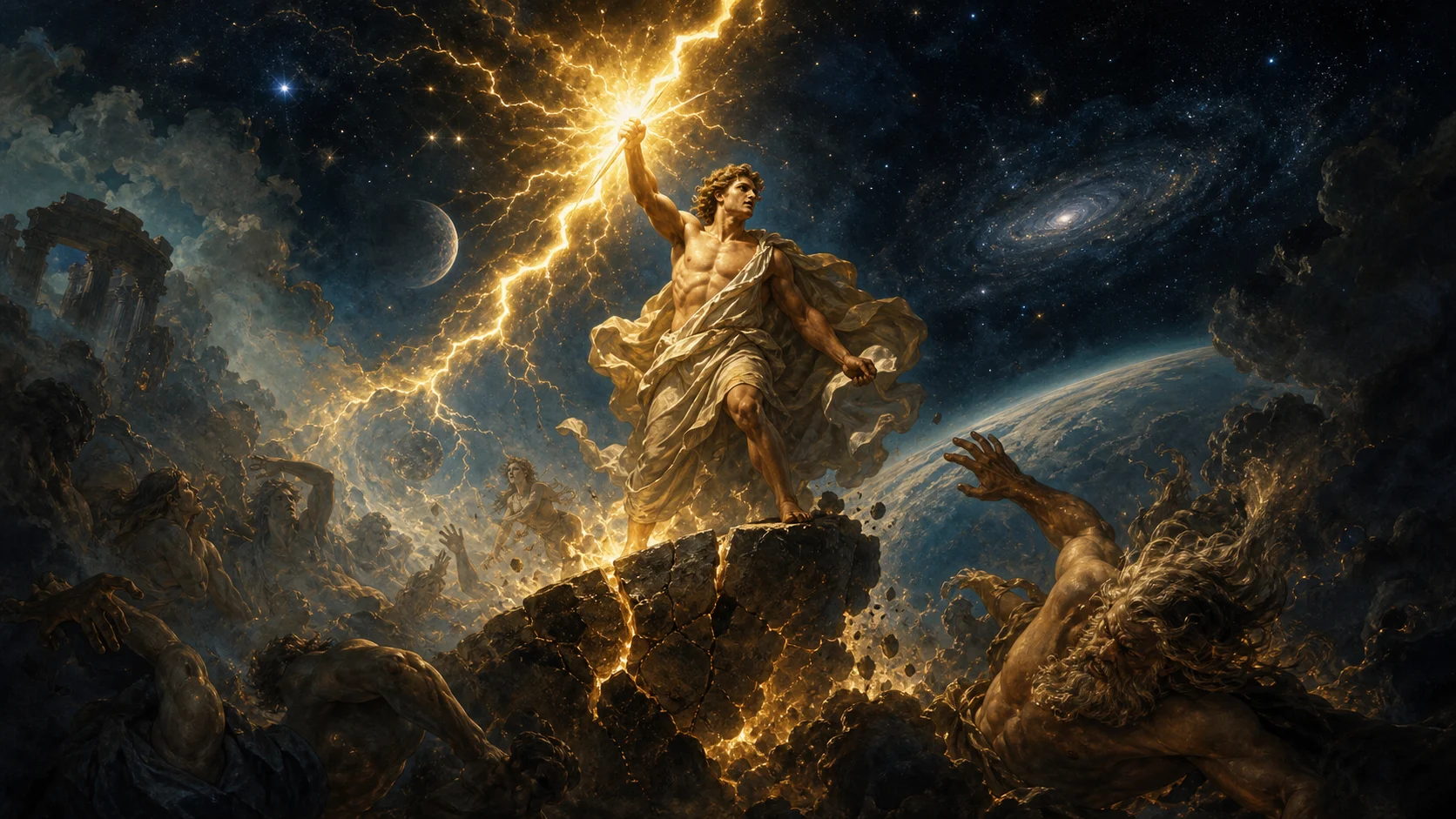
Now the conflict becomes open. Zeus gathers the younger gods. He frees allies imprisoned in the depths, especially the Cyclopes and the Hundred-Handers, and they arm him for kingship. The Cyclopes place in his hand the thunderbolt, the weapon that becomes the clearest sign of Olympian rule. The war that follows, the Titanomachy, lasts ten years. It is not a brief revolt but a world-level struggle that decides who will govern heaven, earth, and the hidden places below.
In the end Zeus and his allies prevail. The Titans who fought against him are driven down into Tartarus and guarded there. Order has been won, but it is a hard-won order secured by force, alliances, and memory. After the victory Zeus and his brothers divide the cosmos: Zeus takes the sky, Poseidon the sea, and Hades the underworld, while Earth and Olympus remain shared spaces where all their claims still touch.
The New Order Is Still Tested
Even after the Titans fall, the world is not finished. Greek myth keeps pressing the question of whether power can ever be completely secure. The Giants rise against Olympus. Later still, Typhon, a monstrous force associated with storm and cosmic upheaval, challenges Zeus himself. Zeus defeats these enemies too, and each victory confirms that his kingship is not merely inherited but defended against chaos over and over again.
That is why the rise of Zeus matters so much in Greek mythology. It is not just the story of how one god became king. It is the story of how the Greek imagination understood order itself: as something built on earlier disorder, constantly shadowed by the possibility of return. The Olympian world is more stable than what came before it, but it never loses the memory of what had to be overcome to make it.
Why This Story Lasts
The Greek creation story remains powerful because it treats the universe as dramatic from the very beginning. Time devours its children. Mothers rebel against fathers. Younger gods fight to breathe. Rule exists, but it is never innocent. By the time Zeus sits on Olympus, the cosmos already carries a family history of fear, revolt, and succession.
That is the key to many later myths. Heroes are born into a world that is ordered, but only provisionally. Divine justice exists, yet the gods themselves remember what it means to seize power. Greek mythology begins with creation, but it becomes unforgettable because creation is also a struggle for who gets to define reality.
Sources and Tradition
- This retelling follows the broad Hesiodic succession pattern summarized in Wikipedia’s Greek mythology overview.
- For the Titan genealogy and the rise of Zeus, see Theoi on Gaia, Ouranos, Kronos, and Zeus.