The story of Heracles is not simply the record of a strong man defeating monsters. In Greek myth, Heracles becomes great by enduring degradation as much as danger. He is the strongest of heroes, yet he spends much of his life obeying commands, serving a lesser king, and paying for a crime born from divine hostility and madness.
Why the Labors Begin
Heracles is the son of Zeus and the mortal woman Alcmene, and from the beginning Hera hates him as the living sign of her husband’s infidelity. Greek tradition surrounds his life with attacks, persecutions, and trials. In one of the darkest turns of the myth, madness falls upon him and he destroys what he most loves. To atone, and also because fate places him beneath another’s authority, he must serve King Eurystheus of Mycenae.
That arrangement is crucial. Heracles does not choose his labors as glorious adventures. They are assigned. The mighty hero must take orders from a weaker man who fears him. Greek myth is fascinated by this humiliation. Strength by itself is not yet greatness. Greatness appears when strength is forced to endure command without breaking.
The First Six Labors
The early labors establish the scale of the challenge. First comes the Nemean Lion, a beast whose hide cannot be pierced by ordinary weapons. Heracles learns that force must sometimes change form: when arrows fail, he closes with the creature and strangles it. He then wears its skin as a visible sign that he has turned an enemy’s invulnerability into his own.
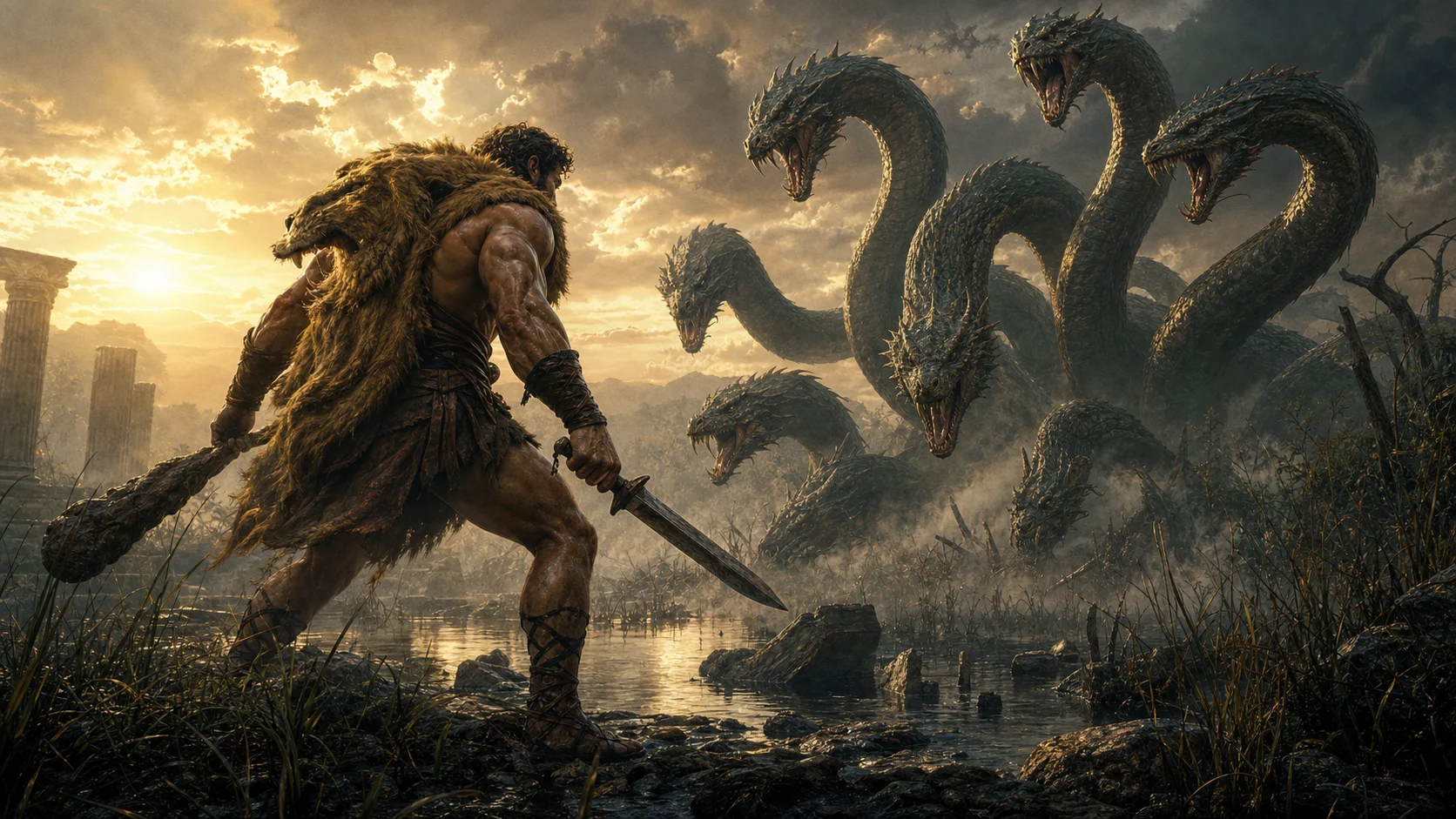
Next comes the Hydra of Lerna, whose severed heads grow back in multiples. This labor shows that not every problem yields to repeated blows. Heracles needs help from Iolaus, who cauterizes the necks after each strike so the heads cannot return. Greek myth here makes a subtle point: even the strongest hero sometimes needs assistance and method.
The third and fourth labors, the Ceryneian Hind and the Erymanthian Boar, test pursuit and capture rather than slaughter. Heracles must seize what is swift or overwhelming without always destroying it. The fifth labor, cleaning the Augean stables, turns brute heroism into engineering. Instead of shoveling filth by hand, he diverts rivers through the place. The sixth labor sends him against the Stymphalian Birds, a plague of sharp-beaked terror that he drives out and destroys.
By now the pattern is clear. The labors are not all the same kind of feat. Some demand wrestling strength, others speed, others patience, others invention. Heracles becomes a complete hero not by doing one thing better and better, but by surviving different kinds of impossibility.
The Distant and More Dangerous Tasks
The later labors widen the world. Heracles is sent to Crete for the great bull, to Thrace for the man-eating mares of Diomedes, and to the land of the Amazons for the belt of Hippolyta. Each new command extends the radius of his fame and suffering. He is not merely cleansing Greece of monsters; he is crossing into other realms, confronting foreign dangers, and carrying back proof that even the edge of the world cannot stop him.
Then come the grand western labors. He must seize the cattle of Geryon, the many-bodied being who lives far off under the sunset, beyond lands ordinary men never reach. The journey is almost as heroic as the taking itself. Greek myth uses this labor to push Heracles to the limit of the known world and make him a boundary-marker of geography as well as legend.
The eleventh labor brings him to the golden apples of the Hesperides. He does not simply pluck them from a convenient tree. First he must discover where they are, then somehow deal with Atlas, the Titan condemned to bear the heavens. In the most famous version, Heracles takes the sky upon his own shoulders while Atlas fetches the apples. When Atlas returns and tries to leave the burden with him, Heracles outwits him and escapes. This moment matters because it shows the hero winning not through muscle alone, but through tactical intelligence.
Cerberus and the Edge of Death
The final labor is the descent to the underworld for Cerberus, the hound that guards the dead. Here the myth reaches its highest symbolic point. Heracles has fought monsters on earth, in wilderness, across sea routes, and at the margins of the world. Now he must enter death’s own realm and return.
He is allowed to take Cerberus only if he can master the beast without ordinary weapons. So he seizes and subdues the hound by bodily strength alone. To bring Cerberus up from the underworld and then restore him is to prove that the hero can cross even the boundary that defines mortal life. This is why Heracles stands at the border between hero and god more sharply than almost any other Greek figure.
After the Labors
Completion of the twelve labors does not give Heracles a peaceful life. Greek myth rarely grants that. More adventures, wars, loves, and disasters follow. Eventually the poisoned robe connected with Nessus and Deianeira brings him to unbearable agony. He mounts the pyre on Mount Oeta and gives himself to the flames.
Yet the end is not simple death. The mortal part of Heracles perishes, but the divine part is taken up to Olympus. There he is reconciled to the order that tormented him, and his long career of suffering resolves into immortality. This conclusion is essential. The labors do not merely make him famous. They prepare him for apotheosis.
Why This Story Lasts
The twelve labors remain powerful because they are more than a sequence of monster fights. They are a map of what greatness costs. Heracles is strongest when he is most constrained, most admirable when he is least free, and most heroic when force alone is not enough. The labors turn suffering into action and action into legend.
That is why Heracles became one of the central heroic models in the ancient world. He is not noble because life is easy for him. He is noble because he continues through tasks designed to degrade, exhaust, and finally destroy him, and still emerges as the mortal most capable of touching the divine.
Sources and Tradition
- This retelling follows the broad heroic arc outlined on Theoi’s Heracles page together with the Atlas material on Theoi’s Atlas page.
- For wider reference context, see Wikipedia on Heracles and the long public-domain tradition represented by Bulfinch’s chapter on Hercules.