The story of Icarus is often reduced to a proverb about flying too close to the sun. But the full myth is sadder and richer than the proverb. It is about imprisonment after cleverness, a father’s art turned toward escape, and the terrible instant when freedom becomes excess.
Daedalus in Crete
Daedalus is the great craftsman of Greek myth, a maker whose skill seems almost magical even when it remains human. He builds devices, statues, and above all the labyrinth of Crete, the winding prison that holds the Minotaur. Yet Greek myth has a way of trapping the clever within their own inventions. After helping Ariadne and Theseus, Daedalus falls out of favor with King Minos and finds himself confined on the island with his son Icarus.
Minos controls the sea routes closely enough that ordinary escape is impossible. Ships can be watched. Harbors can be guarded. Daedalus therefore turns to the one path still open: the air. The plan is daring because it is both practical and impossible at once. No god gives him ready-made wings. He must invent them.
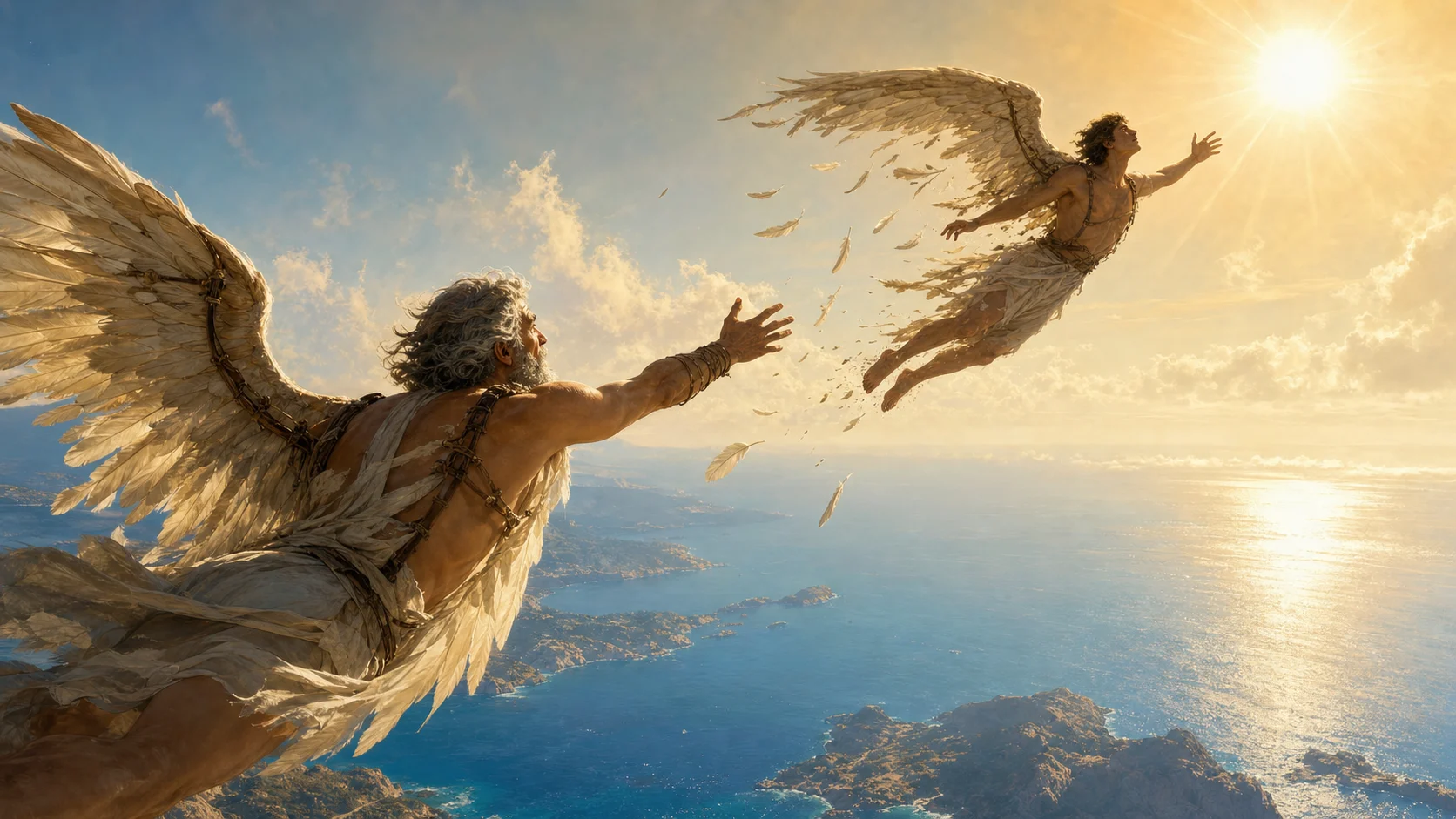
He gathers feathers of different sizes and fastens them into broad surfaces, binding the larger with thread and the smaller with wax. The construction is careful, almost tender. The story lingers over the workmanship because the tragedy depends on it. These are not magical ornaments. They are tools made by patience, intelligence, and human hands.
The Warning
When the wings are finished, Daedalus teaches Icarus how they must be used. The warning is exact and balanced. Fly neither too low nor too high. Too low, and the sea spray will soak and drag the feathers down. Too high, and the sun’s heat will soften the wax. Safety lies in the middle path, in obedient skill rather than ecstatic risk.
This is one reason the myth endures. The father is not warning against joy itself. He is warning against forgetting that joy still takes place in a physical world with limits. To fly is wondrous, but wonder does not abolish structure.
The two rise into the air and leave Crete behind. From below, shepherds and farmers see them crossing the sky and think they must be more than human. That image is important. For a moment the invention works so perfectly that mortals seem divine. The myth lets us feel the intoxication before it punishes it.
Icarus Rises
At first Icarus follows. Then delight overtakes discipline. The boy feels lift, speed, and sunlit space all around him and begins to climb. The farther he rises, the more the flight ceases to be an escape plan and becomes an experience of exhilaration for its own sake. Greek myth does not mock that feeling; it understands it. That is why the fall hurts.
The heat of the sun softens the wax. The structure fails. Feathers scatter. Icarus beats his arms, but the motion no longer holds him. The same sky that had seemed to welcome him now offers nothing to stand on. He falls into the sea below, crying out to his father as he goes.
Daedalus survives, but survival is no victory. He circles, calls the boy’s name, and sees feathers on the water where his son has disappeared. The place remembers what happened. Sea and nearby land take Icarus’s name, as though Greek myth insists that grief be written into geography so that forgetfulness cannot finish the tragedy.
More Than a Moral Sentence
It is easy to turn the story into a single lesson about arrogance. That lesson is there, but the myth is larger than that. Icarus is not a tyrant struck down for impiety. He is a child or youth overtaken by the ecstasy of doing what had seemed impossible. Daedalus too is not simply the wise opposite. His genius created the possibility of the flight, but genius could not protect it forever.
The story is also about a recurrent Greek theme: human art can achieve astonishing things, but it does not make human beings gods. Skill opens the way. It does not erase vulnerability. Daedalus can shape feathers into wings, yet he cannot build a world without danger for the son who uses them.
Why This Story Lasts
Icarus lasts because the myth understands both sides of aspiration. It knows why human beings long to rise, experiment, and test themselves against the impossible. It also knows how quickly wonder can become overreach when delight stops listening to instruction. The image of melting wax is memorable not because it is spectacular, but because it makes collapse feel intimate. What fails is not a weapon or a fortress. It is handiwork.
That is why the tale remains moving even after it becomes proverbial. Beneath the warning stands a father watching the sky, a son discovering too late that exhilaration has weight, and a world in which even the greatest inventions cannot rescue mortals from grief.
Sources and Tradition
- This retelling follows the classical story preserved in public-domain sources such as Bulfinch’s chapter on Theseus and Daedalus.
- For modern reference summaries of the standard version, see Wikipedia on Icarus and Daedalus.