
The quest for the Golden Fleece is one of the great voyage stories of Greek mythology. It combines dynastic grievance, far-sea adventure, impossible tasks, and the dangerous truth that a hero may win fame only because someone else pays the deeper moral price.
Why the Fleece Matters
The fleece itself already carries an older history before Jason ever seeks it. It belongs to the marvelous golden ram that rescued Phrixus and carried him eastward to Colchis. There the ram is sacrificed, and the fleece is hung in a sacred grove under the guard of an unsleeping dragon. By the time Jason enters the story, the object is more than treasure. It is a sign of kingship, divine favor, and distance from home.
Jason’s own claim begins in Thessaly. His father Aeson is the rightful ruler, but the throne has been taken by Pelias. When Jason comes of age, Pelias does not simply refuse him. Instead he turns danger into policy and sends the young claimant on a quest so difficult it looks like a sentence of honorable death. If Jason seeks the fleece and fails, Pelias is safe. If he refuses, he is unworthy.
So Jason commissions the ship Argo, and with it begins one of the earliest and most famous collective expeditions in Greek myth. The Argonauts are not anonymous sailors but a gathering of remarkable figures. The voyage matters because it expands the heroic world. Greek legend moves from local monster-fights into seaborne exploration toward the remote edges of imagination.
The Voyage East
Different tellings emphasize different stops along the route, but the pattern is consistent: the Argonauts encounter strange peoples, receive prophecies and warnings, and survive obstacles that ordinary crews could not manage. The clashing rocks, hostile kings, and uncertain coastlines all underscore the same truth: Colchis lies at the margin of the known world, and Jason is being asked to return from the edge with a prize no Greek hero has ever brought home.
When he reaches Colchis, Jason makes his request to King Aeetes. The king does not refuse outright. Like many dangerous rulers in myth, he agrees under conditions meant to destroy the petitioner while preserving the appearance of justice. Jason may have the fleece if he can yoke two fire-breathing bronze bulls, plow a field with them, sow dragon’s teeth into the ground, and defeat the armed warriors who spring from that sowing.
Each task is impossible by design. Aeetes is not testing a hero in good faith. He is arranging a death.
Medea’s Help
Jason does not overcome these tasks by solitary heroism. Medea, daughter of Aeetes, sees him and falls in love, whether through Aphrodite’s influence, fate, or the old logic by which Greek myth binds desire to catastrophe. She is not merely a maiden admiring a champion. She is a sorceress whose knowledge changes the entire story.
Medea gives Jason the means to survive the bulls: a charm or drug that protects him from flame and iron. Armed with that aid, Jason faces the bronze-footed creatures, withstands their burning breath, and forces them beneath the yoke. Then he plows the field and sows the dragon’s teeth.
From the earth rise armed men ready to attack him. Here again Jason wins by craft. Following Medea’s instruction, he throws a stone among them, and the earthborn warriors turn on one another in confusion. The hero survives not by defeating each one singly, but by setting the threat against itself.
The Taking of the Fleece
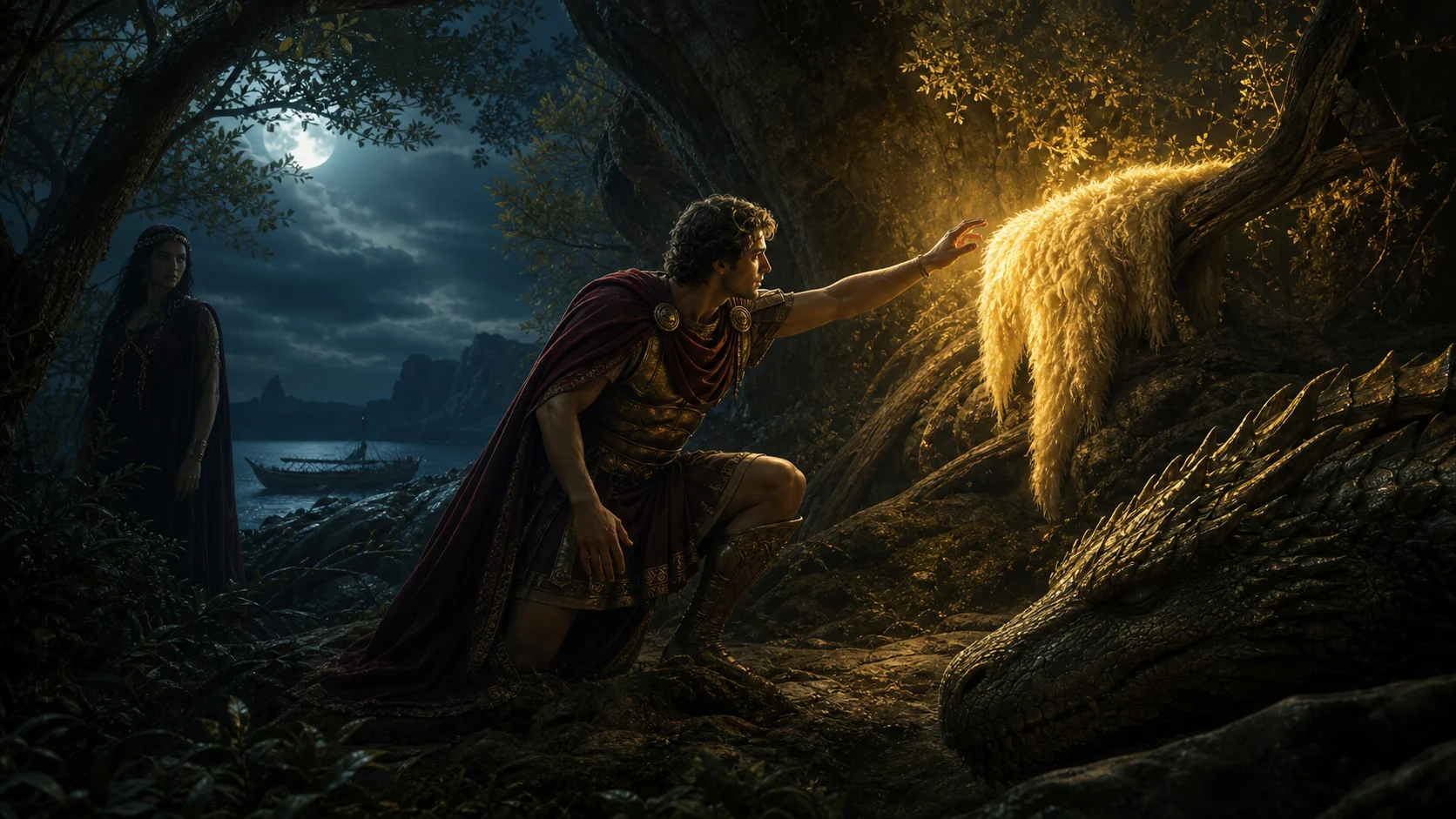
Even after those feats, the fleece is not his. The sleepless dragon still guards it in the sacred grove. Medea intervenes once more, lulling or subduing the serpent so that Jason can seize the hanging golden prize.
This is the climactic image of the myth: the far-famed object at last lifted from the tree and carried away toward the waiting ship. Yet from that instant onward the victory is inseparable from flight. Jason has not won open acceptance. He has taken the fleece under conditions that make return to Colchis impossible.
He and the Argonauts flee with Medea aboard. Ancient versions differ sharply in the details of the pursuit and in the darker acts that follow, especially concerning Medea’s family. Those variations matter because they remind us that the quest, though glorious, already contains the seeds of future ruin. Jason’s greatest triumph is bound to a partnership that later Greek tragedy will make terrible.
The Heroic Version and the Tragic Future
If we stop with the quest itself, Jason appears as the successful adventurer who wins the object demanded of him and comes home with proof of divine-scale courage. But Greek myth rarely leaves stories in that clean condition. Later tradition, especially in drama, insists that Jason and Medea’s story does not end with applause on the dock.
That tension is part of what makes the fleece unforgettable. The voyage is one of Greek mythology’s most exhilarating adventures, yet even at its brightest it depends on broken loyalty, borrowed magic, and a love that will not remain simple. Jason is heroic, but not self-sufficient. Medea is savior, but not safely contained inside a helper’s role. The story is already morally unstable while it still looks like triumph.
Why This Story Lasts
Jason and the Golden Fleece endure because they offer the full texture of mythic adventure: a usurped throne, a legendary ship, a fellowship of heroes, distant seas, impossible tasks, and a treasure worth crossing the world to claim. But the story also survives because it refuses to flatter the hero completely. Jason’s fame depends on help he could not have earned through bravery alone.
In that sense the quest stands at a hinge point in Greek storytelling. It is a magnificent adventure, and also the beginning of one of myth’s darkest entanglements. The fleece shines, but it shines over consequences.
Sources and Tradition
- This retelling draws on Theoi’s materials for the Bronze Bulls, the Colchian Dragon, and hero summaries connected with Jason.
- For the fleece’s earlier mythic background and the larger Greek cycle, see Wikipedia’s Golden Fleece entry and Greek mythology overview.