The story of Medusa and Perseus is one of the clearest Greek examples of a hero being sent to do what should not be possible. The task is not merely to fight a monster. It is to approach something so terrible that the ordinary act of looking becomes fatal.
The Child of Prophecy
Perseus enters the world under a shadow. His grandfather Acrisius hears a prophecy that his daughter’s son will one day kill him. Trying to outwit fate, he shuts Danae away. Yet Zeus reaches her in the form of a golden shower, and Perseus is born. Acrisius does not kill mother and child directly. Instead he places them in a chest and casts them into the sea, as though distance might do what murder would openly admit.
They survive and come ashore on Seriphos, where Perseus grows to manhood. But the island court brings a new danger. King Polydectes desires Danae and wants her son out of the way. So he demands from Perseus an impossible bride-gift: the head of Medusa.
This command matters because Medusa is not just another beast. She is one of the Gorgons, terrible sisters whose sight turns living beings to stone. In the older Greek tradition, Medusa is the only mortal one among them, which is precisely why she can be hunted at all. The quest is therefore a test of more than bravery. Perseus must find the single vulnerable point inside a world of horror.
The Weapons of Indirect Sight
Perseus does not succeed by strength alone. Greek myth is explicit that divine assistance makes the deed possible. Athena and Hermes guide him. He must learn the hidden road to the Gorgons and gather the tools that let him approach without being destroyed.
Different sources arrange the details differently, but the usual sequence includes the Gray Women, the strange sisters linked to the Gorgons, and the nymphs who possess the needed objects. Perseus receives winged sandals for swift movement, a special pouch in which the head can be carried safely, a curved blade for the stroke itself, and above all a polished shield from Athena.
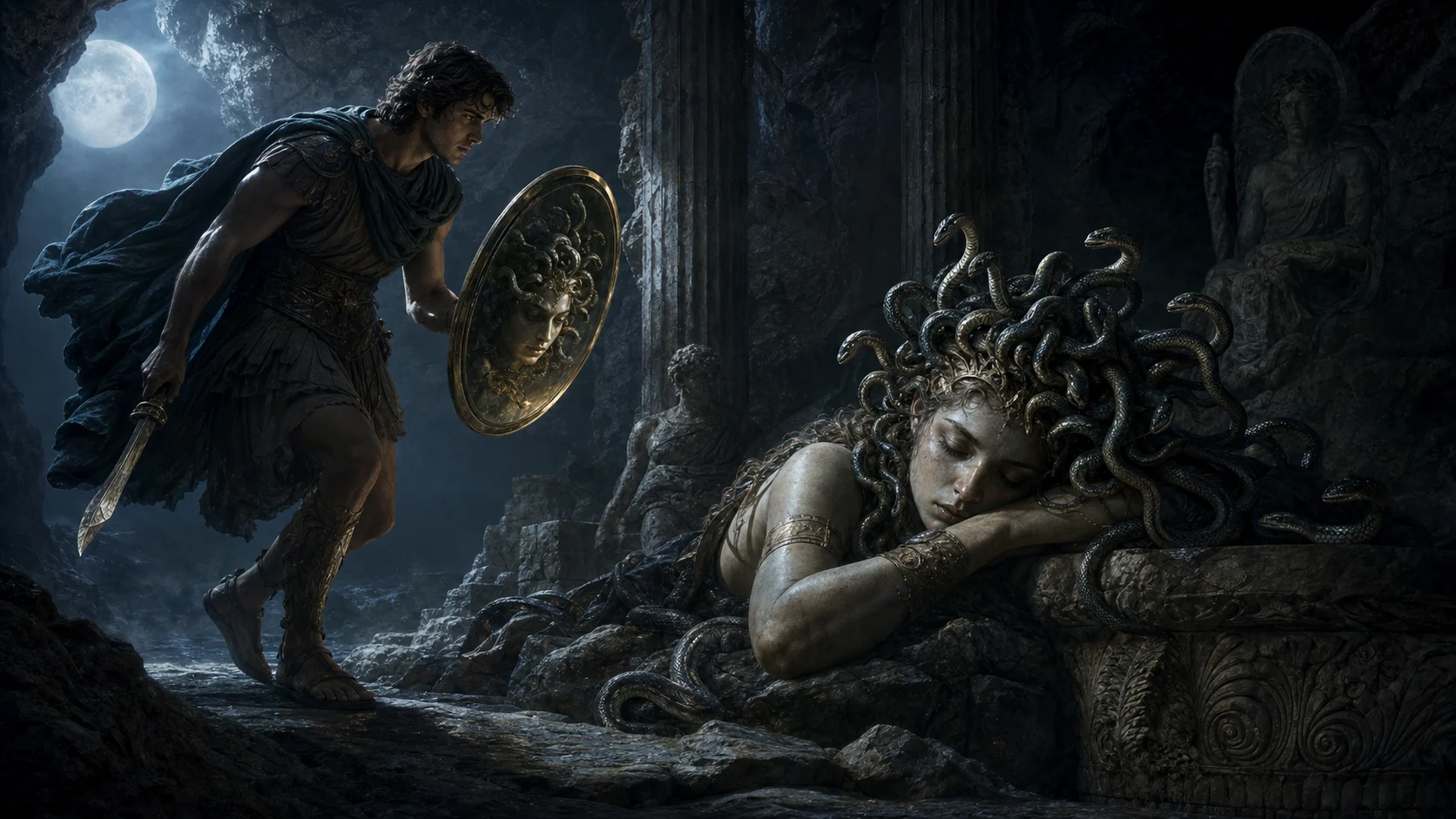
That shield changes the nature of the story. Perseus does not stare directly at Medusa. He watches her by reflection. This is why the myth lasts beyond its monster plot. The hero wins not by meeting horror head-on in a raw display of force, but by disciplined perception. He must learn how to see what cannot be seen directly.
The Beheading of Medusa
At last Perseus reaches the Gorgons. They are asleep. That detail gives the scene its eerie stillness: the deadliest creatures in sight lie motionless, and the hero must move within inches of ruin without a single mistake. Guided by the image in Athena’s shield, he approaches Medusa and strikes.
The blow succeeds. Medusa’s head is severed, and from the blood of the slain Gorgon spring Pegasus and Chrysaor, born from her earlier union with Poseidon in some traditions. Even in victory the scene remains uncanny. The monster is not simply removed from the world; she gives rise to further marvels at the instant of death.
Perseus seizes the head and flees. The other Gorgons wake and pursue him, but with the gods’ gifts he escapes. The quest is over, yet the head remains active. It still petrifies. Medusa’s power has not ended; it has changed hands.
The Head After the Quest
The severed head is one of the most striking objects in all mythology because it continues to act long after the battle. Perseus uses it in later episodes against enemies too strong or numerous to defeat by ordinary means. In some traditions he turns Atlas to stone. On Seriphos he uses it against Polydectes and those who mocked or threatened his mother.
In the end the head passes to Athena, who fixes the Gorgon’s image upon her aegis. That transfer matters. The terrifying face moves from wild danger into divine symbolism. What once destroyed by gaze becomes a sign of protective, sanctioned power. The Gorgoneion is frightening, but it is also apotropaic, meant to repel evil.
A Story With More Than One Medusa
Modern readers often meet Medusa first through later versions that describe her as once beautiful and transformed after offending or being violated in Athena’s temple. That famous account comes chiefly from later Roman poetry, especially Ovid. It has deeply shaped modern sympathy for Medusa, and rightly so, because it reveals the tragic dimension later tradition found in her figure.
But if we want the older Greek backbone of the story, the core is Perseus’s quest against the mortal Gorgon, aided by Athena and Hermes, and achieved by reflection rather than direct sight. Both strands now live together in cultural memory. The important thing is not to confuse the later interpretation with the earliest shape of the myth.
Why This Story Lasts
Medusa and Perseus endure because the story is built around a perfect paradox: to conquer the monster, the hero must refuse the ordinary heroic gesture of direct confrontation. He survives by restraint, mediation, and exact timing. The myth also leaves behind one of the richest symbols in Western imagination, the face that is at once terror, power, victimhood, and protection.
That complexity is why the story never settles into only one meaning. It can be read as a monster-slaying tale, a divine quest, a meditation on dangerous beauty, or a reflection on what it takes to face horror without being turned into stone by it.
Sources and Tradition
- The older quest pattern in this retelling follows Theoi’s pages for Perseus and the Gorgons and Medusa.
- For broader background on how this myth sits inside the Greek heroic age, see Wikipedia’s Greek mythology overview and the site’s public-domain classics such as Bulfinch’s chapter on Perseus.