
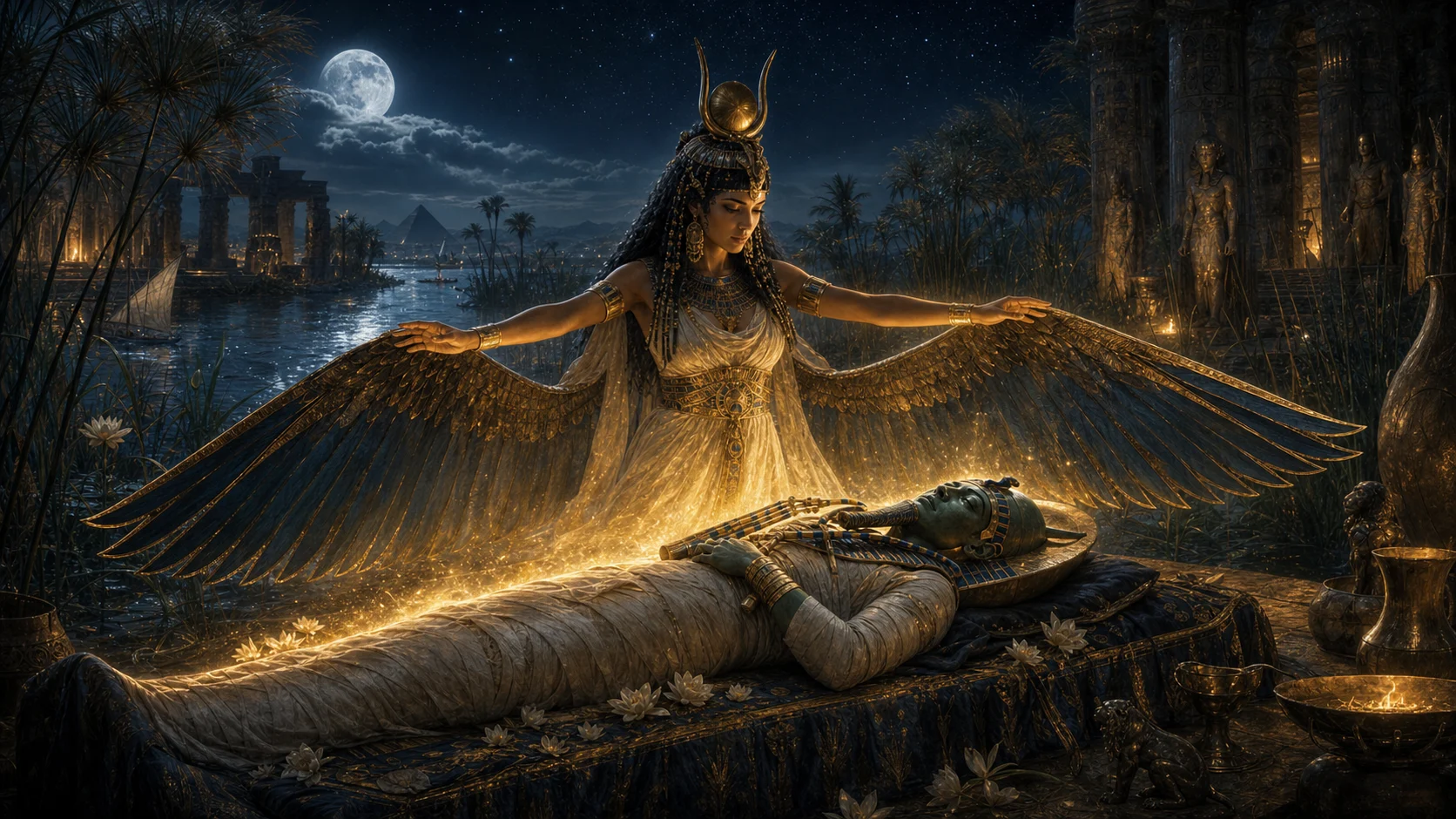
The story of Isis and Osiris is the great family drama of Egyptian mythology: a just king murdered by his brother, a queen who refuses to abandon the dead, a hidden child raised for vengeance and legitimacy, and a restoration that never simply turns time backward. More than almost any other Egyptian myth, it joins political rule, burial ritual, grief, magic, and hope for life beyond death.
It is also important to say at the start that there is no single ancient Egyptian “book” of the myth. The story survives in Pyramid Texts, Coffin Texts, later temple traditions, magical texts, and still later Greek and Roman retellings. The broad shape is stable, but some famous details come from later accounts, especially Plutarch. What follows keeps that fuller traditional arc while noting where the story became more elaborate.
Osiris the Good King
In the myth’s most influential form, Osiris is not merely a death god from the start. He is first remembered as a divine king: one who brings agriculture, law, right worship, and ordered life to Egypt. Ancient and later sources alike connect him with grain, fertility, the Nile’s renewing power, and the civilizing side of kingship. Under his rule, human life becomes settled, fruitful, and ritually ordered.
That kingship matters because Egyptian myth is deeply concerned with maat—truth, rightness, balance, and the proper arrangement of the world. Osiris represents that life-giving order. His brother Set stands closer to violence, storm, disruption, harsh desert power, and dangerous force. In Egyptian thought, Set is not always evil in every context, but in this myth he becomes the destroyer within the royal family itself.
Set’s Treachery
The oldest Egyptian sources do not always tell the murder in full narrative form. They often assume the audience already knows it. Later tradition, especially the famous account preserved by Plutarch, gives the killing a dramatic shape. Set measures Osiris in secret and has a splendid chest made to his exact size. At a banquet he presents it as a prize, promising to give it to whoever fits it perfectly. One by one the guests try and fail. Then Osiris lies down in it.
At once the trap closes. Set and his allies slam down the lid, seal it, and cast the chest into the Nile or send it toward the sea. The scene remains one of the most memorable betrayals in mythology because it turns celebration into murder and hospitality into conspiracy. Osiris is not beaten in honorable combat. He is enclosed, immobilized, and removed from the world of the living.
Isis Searches
When Isis learns what has happened, the myth changes its emotional center. Osiris’s death is terrible, but the story lasts because Isis refuses to let that death become final silence. She mourns openly, wanders in grief, questions all she meets, and searches with the relentless concentration of one who knows that love is now labor.
In the fuller later version, the chest carrying Osiris comes ashore at Byblos, where a tree grows around it and a palace pillar is made from that very trunk. Isis travels there in disguise, serves in the royal household, and finally reveals herself to reclaim what is hidden inside the wood. This episode is especially vivid because it turns mourning into patient intelligence. Isis does not only lament; she tracks, waits, disguises herself, bargains, and acts.
Even where specific versions differ, the central image is consistent across the tradition: Isis is the one who goes after the lost king. She does not sit beside absence. She hunts it.
The Dismemberment and the First Mummy
The restoration is not immediate. In the most famous retellings, Set finds Osiris again and mutilates the body, cutting it into pieces and scattering them across the land. This is one of the reasons the myth became attached to multiple sacred places in Egypt: many local traditions could claim connection to a piece, a tomb, or a memorial of Osiris.
Now the search becomes more desperate and more sacred. Isis is often joined by her sister Nephthys, and in many traditions by Anubis and other funerary powers. The sisters gather what has been torn apart. Egyptian religion saw burial, wrapping, lamentation, and ritual speech not as mere customs but as acts that defended order against decay. In mythic terms, Osiris becomes the first mummy. His restoration by Isis and her allies provides the sacred model behind mummification itself.
This is one of the deepest places where myth and ritual meet. The embalmed dead Egyptian could hope for preservation because Osiris had first been preserved. Funeral lamentation mattered because the divine sisters had first lamented. Myth does not decorate ritual here; it grounds it.
The Conception of Horus
Yet Osiris is not restored to ordinary earthly rule. That is crucial. Egyptian myth does not solve death by pretending it never happened. Isis uses magic, breath, lament, and divine knowledge to revive Osiris only enough to conceive an heir. In some versions she takes bird form and beats life into him with her wings. The image is brief and charged with impossibility: love wrests a future from the dead, but it does not erase the underworld.
The child conceived in that moment is Horus. Osiris then passes fully into his new role as ruler of the dead, lord of the underworld, and king among those who have crossed beyond ordinary life. This is why the myth is about resurrection, but not in the simple sense of a return to everyday kingship. Osiris lives on, yet in a transformed state. His son must carry kingship back into the world above.
Isis in the Marshes
Because Horus is the true heir, Set remains a threat from the moment the child exists. Egyptian tradition therefore places Isis in the papyrus marshes of the Delta, hiding and nursing her son in seclusion. This is one of the most beloved Egyptian images: Isis holding or nursing the divine child, protecting him from venom, beasts, pursuit, and all the exposed weakness of infancy.
Magical texts especially dwell on this part of the myth. Horus is vulnerable. He can be stung, sickened, endangered. Isis becomes the archetypal protective mother and the supreme healer who knows the right names, spells, and appeals to save the child. That role later mattered far beyond this one story. Egyptians invoked Isis as protector in childbirth, healing, and danger because she had already protected the divine heir in the reeds.
Horus Against Set
When Horus reaches maturity, the myth enters its final great phase: the contest for kingship. In Egyptian tradition this conflict can take the form of combat, lawsuits, divine assemblies, magical contests, humiliations, reversals, and endurance. It is not always one single duel. It is a prolonged struggle over legitimacy.
Set is powerful, ancient, and dangerous. Horus is the son of the murdered king, the rightful successor, but he must prove and defend that right before gods as well as enemies. Some texts make the dispute feel almost political or judicial, with the gods deliberating over inheritance. Others make it feel more like a cycle of violent tests. Across versions, however, the direction remains clear: the broken order created by Osiris’s death is not repaired until Horus defeats or overcomes Set and rightful kingship is reestablished.
Osiris also remains present in this phase, not as a returned earthly monarch but as the dead father whose legitimacy underwrites the son’s claim. Egyptian kingship took profound meaning from this arrangement: the living king could be aligned with Horus, while the dead king became Osiris. Rule itself was imagined through the logic of this myth.
What the Story Means
The myth of Isis and Osiris became central because it explained several things at once.
First, it explained kingship. Rule is not just force; it is rightful succession defended against usurpation.
Second, it explained mummification and funerary hope. If Osiris could be reassembled, preserved, and enthroned beyond death, then the dead too could hope for continuity rather than annihilation.
Third, it explained why mourning is active rather than passive. Isis changes the world through grief, but only because her grief becomes search, ritual, speech, and action.
Finally, it explained renewal without pretending that death is unreal. Osiris does not walk back into yesterday. He becomes lord of the dead. Horus does not replace grief; he grows out of it. Egyptian religion found hope not by denying rupture, but by insisting that order can be rebuilt on the far side of it.
Why This Story Lasts
Many myths tell of murdered kings or avenging sons. This one lasts because of the specific emotional intelligence it gives to each figure. Osiris is not only victim but the pattern of blessed dead kingship. Horus is not only avenger but the embodiment of legitimate succession. Set is not random evil but violence that seizes the center and calls itself power. And Isis is not merely supportive. She is the myth’s moving force: queen, mourner, magician, mother, investigator, healer, and restorer.
That is why the story spread so widely and stayed alive for so long. It gave ancient Egypt a language for burial, dynasty, grief, legal legitimacy, and the continuing life of the dead. Even now, it feels intensely human while remaining unmistakably sacred.
Sources and Tradition
- For the broad ancient Egyptian story pattern and its many textual sources, see Wikipedia on the Osiris myth and Egyptian mythology.
- For the later classical synthesis that preserves the famous chest, Byblos, and dismemberment episodes in full narrative form, see Plutarch’s Isis and Osiris.
- For concise deity context, see Britannica on Osiris, Wikipedia on Isis, Osiris, Horus, and Set.